Choosing between an oscillating multi tool and an angle grinder can be confusing. Both are essential for cutting, grinding, and shaping, but they serve different purposes. This guide breaks down their strengths, differences, and ideal use cases—so you can pick the right one for your next project.
What Is an Oscillating Multi Tool?
How It Works
An oscillating multi tool moves its blade or accessory in a rapid side-to-side motion — tens of thousands of times per minute, but only by a few degrees each swing. This tiny oscillation angle gives it remarkable control. Rather than spinning like a saw blade, it vibrates, allowing you to trim, sand, and scrape with precision while minimizing the chance of damaging surrounding surfaces.
Because of this motion, the tool can start cuts flush against walls or floors, reach tight corners, and make clean, shallow incisions where other tools simply cannot. Most models use quick-release heads so you can change attachments in seconds.
Design and Components
A typical oscillating multi tool has a compact motor housing, an oscillating drive head, and a universal accessory mount that supports dozens of blade styles. Cordless models commonly use 18- to 20-volt lithium-ion batteries; corded ones run between 200 and 400 watts. Brushless motors run cooler and quieter than brushed versions and often last longer, which is why professionals tend to choose them.
Typical Applications
- Cutting drywall or plywood for outlet boxes.
- Trimming door frames and baseboards when installing flooring.
- Removing old paint, adhesive, or silicone.
- Sanding inside corners and curved edges.
- Cutting through small nails, screws, or copper pipes.
You can think of it as the “finishing surgeon” of your toolkit — the tool you reach for when accuracy matters more than raw speed.
Material Compatibility
Oscillating tools work best on soft to medium materials: wood, PVC, drywall, composites, and non-ferrous metals such as copper or aluminum. They can nibble through thin steel with the right bi-metal blade, but that’s not their comfort zone.
Advantages and Limits
The biggest advantage is versatility. With one machine, you can cut, sand, polish, and scrape simply by swapping attachments. The vibration is gentle enough for one-handed use, and kickback is rare.
However, the trade-off is limited power and shallow cutting depth. It’s not built for long cuts in metal or concrete. For anything heavy-duty, you’ll want a more powerful grinder.
What Is an Angle Grinder?
How It Works
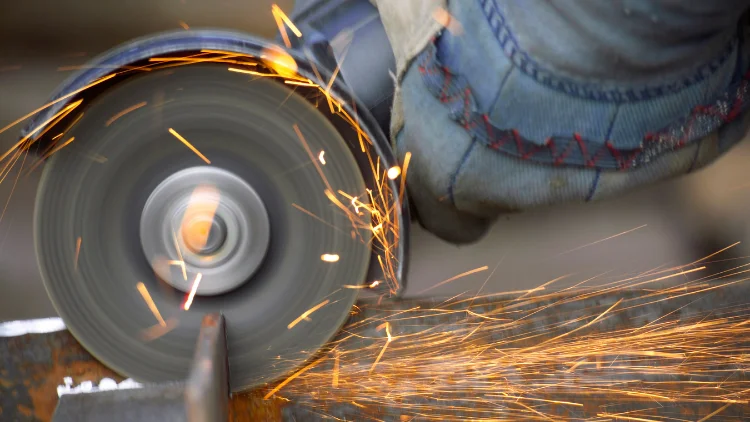
The angle grinder is the muscle of the workshop. Instead of oscillating, its disc spins continuously at 8,000 to 12,000 revolutions per minute. This high-speed rotation generates friction that slices, grinds, or polishes through dense materials. The motor delivers high torque, which means it won’t stall easily under load.
Types and Core Parts
Grinders come in both corded and cordless forms. Corded models range from 800 to 1,200 watts, while cordless versions use 18- or 36-volt batteries. The key parts include a side handle for control, a guard for safety, and a spindle lock for changing discs. Disc diameter matters:
- 4.5-inch (115 mm) models are light and agile.
- 7- or 9-inch (180–230 mm) versions provide deeper, faster cuts.
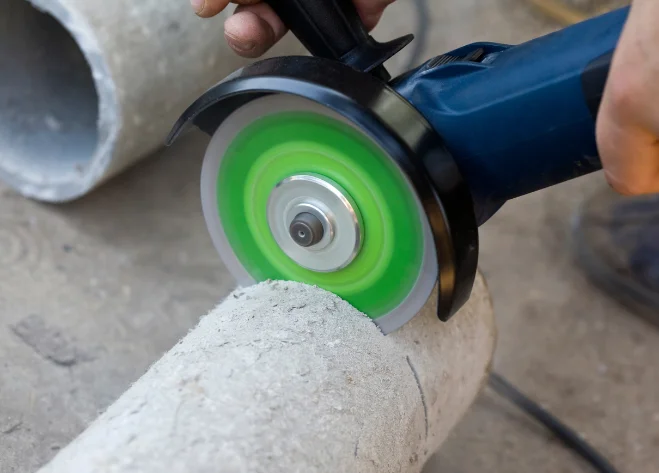
Different attachments change its personality — abrasive discs for metal cutting, diamond blades for concrete, wire brushes for rust removal, and polishing pads for finishing.
Common Use Cases
- Cutting through rebar, bolts, and metal tubing.
- Grinding weld seams smooth.
- Shaping masonry and concrete edges.
- Removing rust, paint, or scale from steel.
- Polishing metal surfaces before painting.
For construction sites and fabrication shops, the angle grinder is indispensable.
Safety Considerations
Because of its power, a grinder demands respect. Sparks fly, discs can shatter, and kickback can occur if you twist mid-cut. Always wear safety glasses, gloves, and hearing protection. Check that the guard is intact and the disc is rated for your tool’s speed.
Advantages and Limits
The grinder’s strength lies in its sheer cutting force. It powers through tough materials fast and can handle hours of continuous use. The downsides are noise, vibration, and weight. For detailed or delicate work, it’s often overkill.
Oscillating Multi Tool vs Angle Grinder: Key Differences
| Feature | Oscillating Multi Tool | Angle Grinder |
| Power Output | 200–400 W or 18–20 V battery | 800–1,200 W or 18–36 V battery |
| Motion Type | Side-to-side oscillation | Continuous rotation |
| Speed | 5,000–20,000 OPM | 8,000–12,000 RPM |
| Cutting Depth | Shallow (under 1 in / 25 mm) | Deep (over 2 in / 50 mm) |
| Precision | High | Medium |
| Material Range | Wood, PVC, drywall, soft metals | Metal, stone, concrete |
| Ease of Use | Beginner-friendly | Requires experience |
| Safety | Minimal spark or kickback | Sparks, noise, stronger recoil |
| Weight | Light (1–2 kg) | Heavy (2–4 kg) |
| Best For | Detail cutting, sanding, scraping | Heavy cutting, grinding, shaping |
How to Choose Between an Oscillating Multi Tool and an Angle Grinder
Consider the Type of Work You Do
Start by matching the tool to your workload. If your projects mostly involve home renovation, trimming, sanding, or light repair, an oscillating multi tool offers better control and less mess. It’s ideal for precise cuts in small areas or where you can’t afford to overcut.
In contrast, if you routinely cut metal, grind welds, or shape concrete, the power and endurance of an angle grinder are essential. It’s built for demanding work where speed and strength outweigh finesse.
Match the Tool to the Material
Different materials demand different levels of force and precision.
- Wood, drywall, and PVC: Best handled by a multi tool’s fine oscillating blades.
- Steel, cast iron, and concrete: Require the brute torque of a grinder with a cutting or diamond disc.
- Aluminum and copper: Can go either way—use a fine-tooth blade on a multi tool for small jobs, or a grinder for thicker pieces.
Assess Your Skill Level and Safety Comfort
Oscillating multi tools are far more forgiving for beginners. They produce minimal kickback, generate few sparks, and can be operated safely with one hand.
Angle grinders, while powerful, require more awareness and protective gear. If you’re new to power tools, start with the multi tool until you gain confidence and control.
Think About Portability and Workspace Constraints
Working in tight spaces like under cabinets, near walls, or inside a car body? The compact head of an oscillating tool fits where a grinder never could.
On open worksites or outdoor environments, a grinder’s longer reach and faster throughput become advantages. Cordless versions of both tools are improving rapidly, so battery life and compatibility may also influence your decision.
Factor in Cost, Maintenance, and Attachment Availability
Oscillating tools usually cost less upfront, and their accessories—blades, scrapers, and sanding pads—are inexpensive.
Angle grinders, while still affordable, consume cutting discs more quickly. Both tools require occasional maintenance: cleaning dust vents, replacing worn attachments, and checking battery health for cordless models.
Conclusion
In short, an oscillating multi tool excels in precision, detail work, and versatility, while an angle grinder dominates in power and speed. For most professionals and DIYers, having both in your toolkit offers the best flexibility.
If you’re looking for reliable, professional-grade equipment that’s built to last, consider Kafuwell’s line of oscillating multi tools, angle grinders, and other power tools—engineered for safety, durability, and high performance across a wide range of tasks.