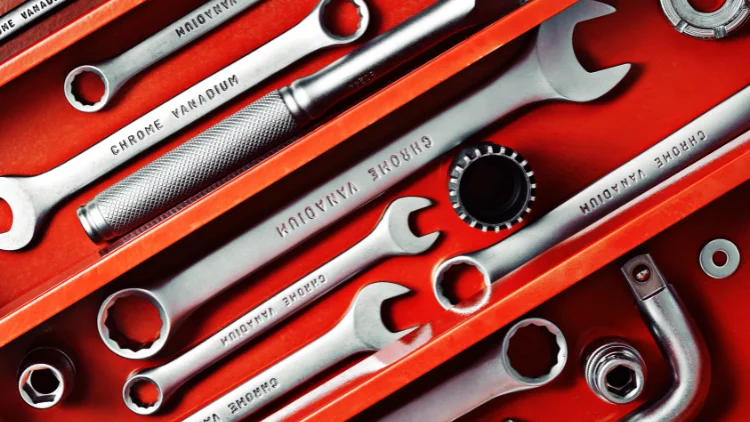
When people buy hand tools, they usually focus on a few things: price, brand, and size.The small line of text stamped on the tool, such as “CR-V” or “Carbon Steel,” is often ignored.
But in reality, that line of text largely determines how tough the tool will be in the long run.Durability, wear resistance, corrosion resistance, and even whether a wrench will bend when you really crank on it are all closely related to the type of steel used.
This article explains the difference between chrome vanadium steel (CR-V) and plain carbon steel commonly used in hand tools, and how they affect the actual service life and performance of a tool.
What Is Carbon Steel in Hand Tools?
“Carbon steel” is a broad term. In hand tools, it usually refers to a type of steel that is mainly iron and carbon, with relatively low levels of other alloying elements.
Typical characteristics of carbon steel in tools include:
- A relatively simple composition
- With proper heat treatment, the strength can reach practical levels
- The hardness can be adjusted through different heat treatment processes
- On its own, corrosion resistance is average, so it usually needs additional surface protection
(paint, black oxide, plating, etc.)
For many types of hand tools, carbon steel is completely sufficient, especially for:
- General household use and occasional repairs
- Applications that don’t require very high torque or constant “all-out” force
- Products that need to stay in the low or mid price range
However, because it contains fewer alloying elements, carbon steel tends to be weaker in:
- Wear resistance
- Corrosion resistance
- Maintaining its shape under repeated heavy loads
That’s where alloy steels like chrome vanadium come into play.
What Is Chrome Vanadium (CR-V) Steel?
Chrome vanadium steel (usually marked as “CR-V” on tools) is a type of alloy steel.
On top of iron and carbon, it includes additional elements such as:
- Chromium (Cr)
- Vanadium (V)
- And sometimes small amounts of manganese, molybdenum, and others
These alloying elements significantly change the properties of the steel:
- Chromium can improve hardenability and corrosion resistance
- Vanadium can refine the microstructure and increase strength and toughness
- With a proper combination and heat treatment, the steel can maintain relatively high hardness without becoming too brittle
Because of this, chrome vanadium steel is very suitable for tools that need to withstand high torque and repeated impact, such as:
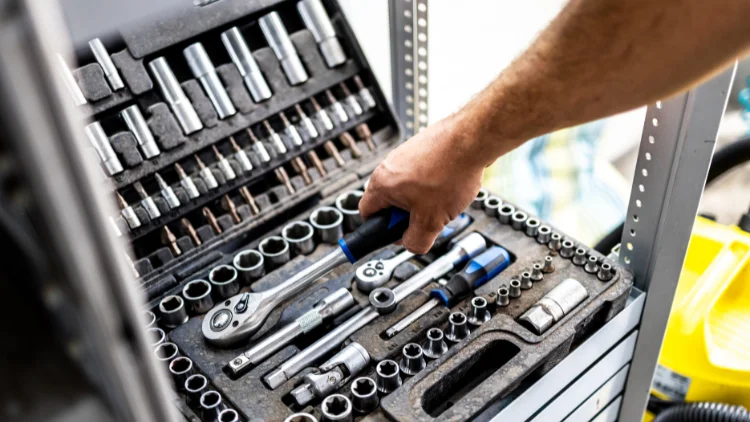
- Various wrenches and ratcheting wrenches
- Sockets for impact wrenches
- Bits and screwdriver shafts
- Certain types of pliers
What Does “Durable” Really Mean for a Hand Tool?
Before comparing CR-V and carbon steel, it helps to break down the word “durable.”
For hand tools, durability usually includes the following aspects:
Strength
Whether the tool will bend or break when used with a lot of force.
Hardness and Wear Resistance
How long the working areas (such as wrench openings, socket corners, screwdriver tips) take to become rounded, worn smooth, or chipped.
Toughness
Whether the tool will crack or shatter when it encounters impact or a sudden overload.
Corrosion Resistance
How long it takes for the tool to rust when stored in a humid environment, outdoors, or in a vehicle.
Quality of Heat Treatment
Even with good steel, if hardening and tempering are done poorly, the tool can still be very brittle or very soft.
Heat treatment can be just as important as the material itself.
Machining Accuracy and Fit
For example, socket size accuracy, whether wrench openings fit properly, and surface finish — all of these affect long-term wear during use.
Material is only one part of the story, but it is the foundation.
Only with good steel + proper heat treatment + solid manufacturing can you make a truly durable tool.
How Do CR-V and Carbon Steel Perform Differently?
Resistance to Bending and Deformation
For tools that need to withstand high torque, such as:
- Adjustable wrenches, box-end wrenches, open-end wrenches
- Sockets, breaker bars, torque bars
CR-V is generally designed and heat treated to a higher strength level to resist:
- Long periods of heavy tightening or loosening of bolts
- Occasional “over-torquing” beyond normal use
Carbon steel tools, with proper heat treatment, can also reach decent strength.
But under repeated heavy loads, they are more likely to:
- Slowly bend out of shape
- Develop widened openings and distorted corners
Hardness and Wear on Working Surfaces
What really determines user experience is the service life of the contact surfaces, such as:
- The flats and corners inside a wrench opening
- The edges inside a hex socket
- The tip or edges of a screwdriver or bit
CR-V steel, under well-controlled heat treatment, can reach higher and more stable hardness levels, which leads to:
- Edges that are less likely to wear round
- Less chance of slipping on fasteners
- Longer overall service life
Carbon steel can also be hardened, but it usually has to compromise between being hard enough to resist wear and not so hard that it becomes brittle.
On some low-cost products, this balance may not be handled well, which can result in tools that are either too soft or, on the other hand, more prone to chipping.
Corrosion Resistance
The chromium in CR-V can improve corrosion resistance to a certain extent.
Most tools, whether made from CR-V or carbon steel, will still receive a surface treatment, such as:
- Chrome plating
- Black oxide
- Phosphate coatings, etc.
But once the plating is worn through or scratched:
- CR-V base metal usually rusts more slowly
- Carbon steel tends to show red rust more easily, especially in humid or coastal regions
For people who work outdoors, in temporary jobsite shelters, or out of a vehicle, this difference becomes noticeable over time.
Impact and “Accidents”
In real use, tools don’t just see smooth, steady loads. More often they are:
- Hit with a hammer
- Dropped
- Occasionally used with “brute force”
At that point, you need a certain level of toughness, not just hardness.
With reasonable heat treatment, CR-V can usually balance:
- High strength
- Decent toughness
Carbon steel shows a wide range of behavior:some grades, when treated well, are tough enough; others, if pushed too hard for hardness during heat treatment, become more brittle and more likely to chip or crack.
This is also why, in more critical and highly stressed parts, many manufacturers prefer CR-V or other alloy steels over plain carbon steel.
Which Material Is Actually “Better”?
There is no absolute answer here, but a few clear trends do exist.
When Is Carbon Steel Enough?
For many light-duty applications, carbon steel tools are actually sufficient, for example:
- Occasionally tightening screws or fixing furniture at home
- Simple installation and assembly work
- Situations where you don’t apply high torque for long periods
If the user:
- Does not use tools very frequently
- Works mainly indoors in relatively dry conditions
- Has a limited budget
then a set of well-made carbon steel tools with suitable anti-rust surface treatment can be an acceptable choice.
When Does CR-V’s Advantage Become Obvious?
CR-V’s strengths show up more clearly in these situations:
- Tools are used often, even every day
- You frequently deal with rusty fasteners, large bolts, and high-torque situations
- Work involves automotive repair, machinery maintenance, construction, etc.
- Tools are stored in vehicles, on job sites, or in humid workshops
In these scenarios, CR-V tools typically offer:
- Less deformation and fewer “stretched” openings
- Lower risk of rounding off fasteners
- Longer overall service life
What Else Matters Besides the Material?
Even with good steel, if other aspects are not up to standard, the tool can still be disappointing.
Besides “CR-V or carbon steel,” these factors are also critical:
Heat Treatment Process
The balance between hardness and toughness depends entirely on the hardening and tempering process.
The same steel grade can perform very differently with different heat treatments.
Structural Design
Wall thickness, how the load path is arranged, and whether there are stress concentration points all affect which part of the tool fails first under heavy force.
Machining Accuracy
Whether sockets and wrench openings are accurately sized determines how the load is distributed on the fastener.
Poor accuracy makes tools more likely to slip, damage fasteners, and damage themselves.
Surface Treatment and Coating
Good plating or coatings help protect the base metal from rust, make tools easier to clean, and keep them looking better.
So when judging the quality of a hand tool, you shouldn’t focus only on the steel grade.
Material is a very important indicator, but it is not the only standard.
Summary
If you care more about long-term durability and consistent performance — especially if you often use tools with high force or in less-than-ideal environments — choosing hand tools made from chrome vanadium (CR-V) steel is usually the safer option.
If you only use tools occasionally for simple jobs, a reliable set of carbon steel tools can still do the job perfectly well.