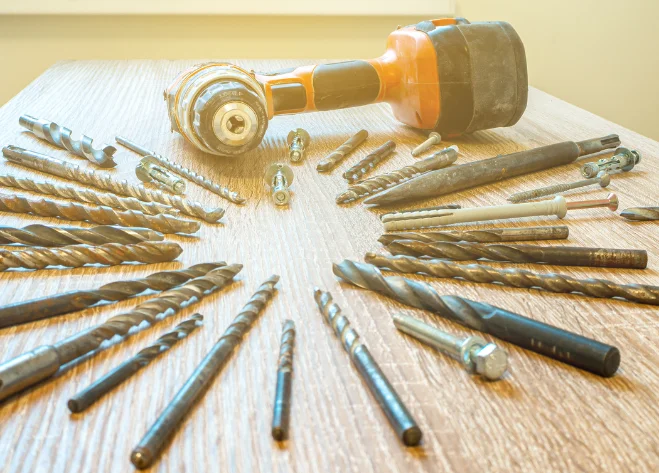
When working on construction, demolition, or other heavy-duty projects, rotary hammers and demolition hammers are two common power tools. They differ significantly in terms of operation, function, and intended use. Sometimes, it can be confusing to know when to use a rotary hammer and when to use a demolition hammer. This article will clarify that, helping you choose the right tool based on your project needs.
Rotary Hammer vs Demolition Hammer: Definitions and Working Principles

Rotary Hammer
A rotary hammer is an electric tool that combines rotary and impact functions, typically used for drilling and light demolition tasks. Its working principle involves a motor driving a piston to generate impact force, while simultaneously incorporating rotational movement to allow the drill bit to quickly penetrate the material.
Demolition Hammer
A demolition hammer focuses on powerful impact and is primarily used for demolition and breaking tasks. Unlike a rotary hammer, a demolition hammer does not have a rotational function. Its working principle is based on the motor driving a piston to produce continuous impact force, which strikes the chisel or chisel head at the front of the tool forcefully onto the target material.
Key Differences Between Rotary Hammers and Demolition Hammers
| Feature | Rotary Hammer | Demolition Hammer |
| Function | Drilling + Light Demolition | Only Demolition |
| Applicable Materials | Concrete, Brick, Stone | Concrete, Asphalt, Marble |
| Weight | Lighter, Suitable for Long-term Use | Heavier, Suitable for High-Intensity Demolition |
| Price Range | Medium, Suitable for Household Users | Higher, Suitable for Professional Construction |
When to Use a Rotary Hammer
A rotary hammer is a versatile tool, suitable for tasks that require both drilling and light demolition. Below are some typical application scenarios:
- Home Renovation: Such as installing pipes, securing brackets, drilling holes, etc.
- Light Demolition: Such as removing tiles, drywall, etc.
- Precise Work: When controlling the depth or position of drilling is necessary.
The advantages of a rotary hammer include:
- Versatility: Can be used for both drilling and light demolition, adapting to a variety of construction needs.
- Moderate Weight: Relatively lightweight, suitable for extended use, reducing operator fatigue.
- Cost-Effective: Priced reasonably, ideal for household users and small-scale construction projects.
When to Use a Demolition Hammer
A demolition hammer is specifically designed for high-intensity demolition tasks, suitable for heavy-duty demolition work. Below are some typical application scenarios:
- Large-Scale Demolition: Such as removing concrete floors, walls, etc.
- High-Intensity Breaking: Handling heavy or hard materials.
- Professional Construction: When efficient, high-intensity operation is required.
The advantages of a demolition hammer include:
- High Breaking Power: Provides powerful impact, ideal for handling hard materials.
- Professional Performance: Designed specifically for demolition tasks, offering high efficiency and excellent results.
- Strong Durability: Built with a robust structure, suitable for long-term, high-intensity use.

Frequently Asked Questions (FAQ)
Can Rotary Hammers and Demolition Hammers Use the Same Accessories?
No. Rotary hammers require specialized drill bits, while demolition hammers require specific chisels. The accessories are designed to fit the unique mechanisms and functions of each tool.
Is There a Significant Price Difference Between Rotary Hammers and Demolition Hammers?
Yes. Demolition hammers are generally more expensive due to their higher impact energy and suitability for heavy-duty tasks.
Rotary hammers are more affordable and are ideal for everyday drilling and light demolition work.
Can a Demolition Hammer Be Used for Drilling?
No. Demolition hammers lack the rotational function required for drilling. They are designed solely for breaking and chiseling tasks.
Can I Use a Rotary Hammer for Large-Scale Demolition?
Not recommended. Rotary hammers are suitable for light demolition tasks, such as removing tiles or breaking through drywall. For extensive demolition work, a demolition hammer is more appropriate due to its higher impact force.
What Safety Precautions Should I Take When Using These Tools?
Always wear appropriate personal protective equipment (PPE), including safety goggles, hearing protection, and gloves. Ensure the work area is clear of obstructions, and always follow the manufacturer’s instructions for safe operation.
Conclusion
Both rotary hammers and demolition hammers have unique advantages, and the right tool depends on your specific project needs.Kafuwell offers a range of high-quality power tools, drill bits, and accessories, all designed to meet your construction and demolition needs. Our expert team will help you select the best tools for your project, ensuring reliable performance and efficient results.